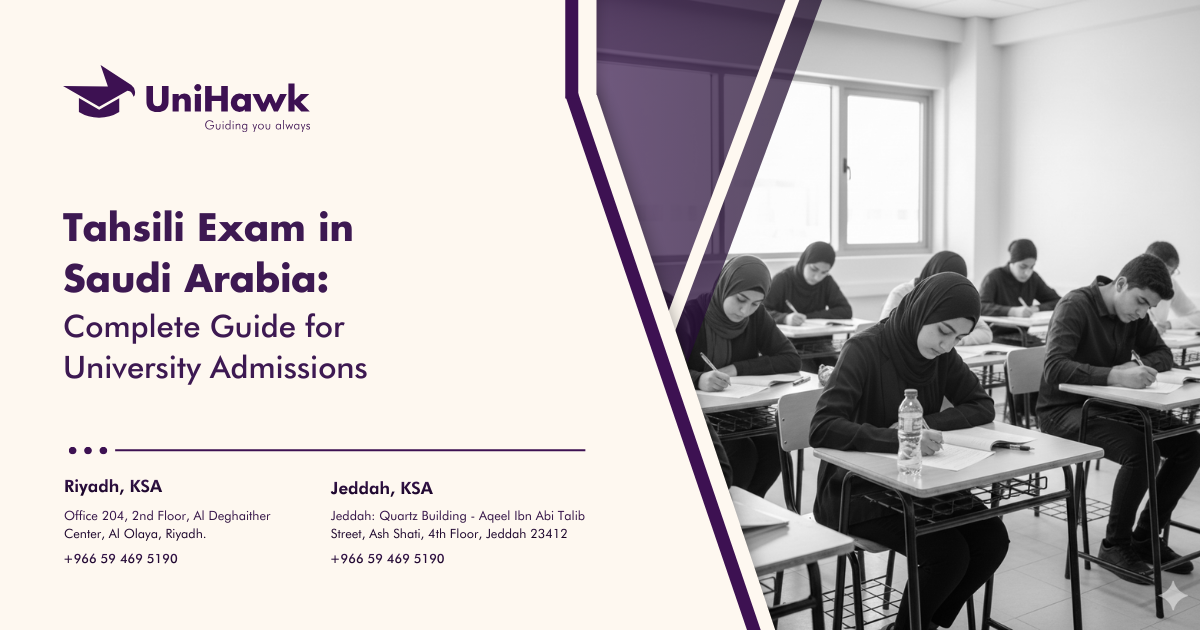
Tahsili Exam in Saudi Arabia: Complete Guide for University Admissions
The Tahsili exam (اختبار التحصيلي) stands as one of the most critical assessments for Saudi high school graduates seeking admission to universities across the Kingdom. Whether you’re wondering how to prepare for Tahsili exam in Saudi Arabia, researching Tahsili exam for university admission in KSA, understanding the Tahsili exam science track, exploring Tahsili exam requirements for medical universities, or seeking a comprehensive Tahsili exam guide for students, this detailed guide provides everything you need to succeed. Understanding the Saudi Tahsili exam thoroughly and preparing strategically can make the difference between admission to your dream program and settling for alternatives.
What Is the Tahsili Exam? Understanding Its Role in Saudi University Admissions
The Tahsili exam, officially known as the Achievement Test (اختبار التحصيلي في السعودية), is a standardized examination administered by the National Center for Assessment (Qiyas) that evaluates students’ mastery of curriculum content studied during their secondary school years. For students pursuing Tahsili exam preparation, understanding that this assessment differs fundamentally from aptitude tests like Qudrat is essential. While Qudrat measures general cognitive abilities, the Saudi Tahsili exam tests specific academic knowledge acquired through your high school curriculum, making thorough content review crucial for success.
The Tahsili exam for university admission in KSA serves as a critical component of the university admission process alongside your high school GPA and Qudrat scores. Most Saudi universities calculate a weighted composite score combining these three elements, with typical weightings of 30% for high school GPA, 30% for Qudrat, and 40% for Tahsili, though exact proportions vary by institution and program. Understanding how your target universities weight these components helps you allocate preparation time strategically and set realistic score targets.
Two versions of the Saudi Tahsili exam exist: one for science track students and another for theoretical track students. The Tahsili exam science track, which most students pursuing engineering, medicine, pharmacy, and other science programs take, covers Mathematics, Chemistry, Physics, Biology, and English. The theoretical track version covers different subjects aligned with humanities and social science curricula. This guide focuses primarily on the science track, as it applies to the majority of competitive university programs including Tahsili exam requirements for medical universities.
Universities across Saudi Arabia rely heavily on Tahsili exam scores when making admission decisions, particularly for competitive programs with limited spaces. The Tahsili exam for university admission in KSA provides standardized data allowing universities to compare applicants from different schools and regions fairly. Strong Tahsili performance can compensate for slightly lower high school GPAs or Qudrat scores, while weak Tahsili results may prevent admission even with excellent grades. Understanding this dynamic emphasizes the importance of serious Tahsili exam preparation regardless of your academic track record.
Tahsili Exam Syllabus: Understanding What’s Tested
Comprehensive understanding of the Tahsili exam syllabus forms the foundation of effective preparation. The Saudi Tahsili exam for science track students covers five subjects, each comprising specific topics from your secondary school curriculum. Unlike comprehensive final exams that test everything you’ve learned, the Tahsili exam syllabus focuses on core concepts and fundamental principles most relevant for university-level study in science and engineering fields.
The Mathematics portion of the Tahsili exam syllabus includes algebra, trigonometry, geometry, calculus, and statistics. Specific topics cover functions and their properties, trigonometric identities and equations, geometric proofs and calculations, differentiation and integration basics, and probability and statistical analysis. Mathematics typically represents about 25-30% of the total exam, making strong mathematical preparation essential for competitive scores. Many students find mathematics both the most challenging and most rewarding section to prepare for, as focused practice can yield significant score improvements.
Chemistry content in the Tahsili exam syllabus encompasses atomic structure, chemical bonding, states of matter, chemical reactions, stoichiometry, thermochemistry, acids and bases, and organic chemistry fundamentals. This section requires both conceptual understanding and ability to apply chemistry principles to solve problems. Memorizing formulas alone proves insufficient; you must understand when and how to apply them in various contexts. The chemistry portion typically comprises 20-25% of the examination.
Physics topics on the Tahsili exam syllabus include mechanics, electricity and magnetism, waves and optics, thermodynamics, and modern physics concepts. Questions test your understanding of physical principles, ability to analyze situations using physics concepts, and skill in solving quantitative problems. Physics problems often require multi-step reasoning, combining several concepts to reach solutions. This section usually represents 20-25% of the total exam.
Biology content covers cell structure and function, genetics and heredity, evolution and biodiversity, anatomy and physiology, and ecology. The biology section emphasizes conceptual understanding of living systems, relationships between biological concepts, and application of biology knowledge to real-world scenarios. This portion typically comprises 15-20% of the examination. Finally, English language content tests grammar, vocabulary, reading comprehension, and written communication skills, usually representing about 10-15% of the total exam. Understanding the complete Tahsili exam syllabus helps you allocate study time proportionally and ensure comprehensive preparation across all subjects.
Tahsili Exam Format and Scoring System
Understanding the Tahsili exam format prepares you for what to expect on test day and helps you develop effective strategies for maximizing your score. The Saudi Tahsili exam is computer-based, administered at designated test centers operated by Qiyas throughout the Kingdom. The total exam duration is approximately 3 hours, during which you’ll answer multiple-choice questions across all five subjects. Questions are not grouped by subject; instead, they’re mixed throughout the exam, requiring you to switch between subjects frequently and maintain focus across diverse content areas.
The Tahsili exam scoring system uses a scale from 0 to 100, with your final score reflecting the percentage of questions you answered correctly. There is no penalty for incorrect answers, meaning you should always select an answer for every question even if you’re uncertain. Random guessing on questions where you’ve eliminated some options statistically improves your score compared to leaving questions blank. Understanding this scoring approach is crucial for how to prepare for Tahsili exam in Saudi Arabia, as it emphasizes the importance of time management and attempting all questions.
Score interpretation requires understanding what different ranges typically mean for university admissions. Scores above 85 are considered excellent and competitive for admission to top programs including medicine, engineering, and pharmacy at prestigious universities. Scores between 75-85 are very good and generally sufficient for admission to quality programs at most universities. Scores between 65-75 are acceptable for many programs, though they may limit options for the most competitive fields. Scores below 65 may restrict university choices significantly, particularly for science and engineering programs.
The Tahsili exam passing score varies by university and program rather than being an absolute threshold. There is no universal “passing” score; instead, each institution and department sets minimum score requirements based on their competitiveness and available spaces. For Tahsili exam requirements for medical universities, scores typically need to exceed 85-90, as medical programs rank among the most selective. Engineering programs at top universities similarly expect scores above 80-85. Understanding your target programs’ typical admitted student profiles helps you set realistic score goals and assess your competitiveness.
The Tahsili exam pattern includes questions of varying difficulty levels, from straightforward recall questions testing basic knowledge to complex application questions requiring synthesis of multiple concepts. Easier questions appear throughout the exam mixed with harder ones, rather than being grouped by difficulty. This pattern means you’ll encounter questions you can answer quickly alongside those requiring more time and thought. Developing strategies for identifying and prioritizing different question types during Tahsili exam preparation improves your efficiency on test day.
How to Prepare for Tahsili Exam in Saudi Arabia: Building Your Study Plan
Effective Tahsili exam preparation requires structured, comprehensive planning that addresses all subjects systematically while accounting for your individual strengths and weaknesses. Most students benefit from 8-12 weeks of focused preparation, though this timeline varies based on your current mastery level, target score, and available study time. Understanding how to prepare for Tahsili exam in Saudi Arabia begins with honest self-assessment of your knowledge in each subject area through diagnostic testing or practice questions.
Start your Tahsili exam preparation guide by reviewing the complete syllabus for each subject, identifying topics you understand well versus those requiring intensive review. Create a detailed study schedule allocating time proportionally to each subject based on its weight in the exam and your current proficiency. Many students make the mistake of only studying their weakest subjects, but maintaining and strengthening your strong subjects is equally important for maximizing your overall score. A balanced approach ensures comprehensive preparation while preventing the frustration of neglecting areas where you could gain points easily.
When developing your Tahsili exam preparation guide for Saudi students, incorporate multiple study methods addressing different learning styles and maintaining engagement. These methods should include reviewing textbooks and class notes systematically, solving practice problems from each subject area, watching educational videos explaining challenging concepts, creating summary sheets or flashcards for key information, teaching concepts to peers or family members to reinforce understanding, and taking regular practice tests under timed conditions. Varying your study approaches prevents monotony and helps information stick more effectively than repetitive use of a single method.
Consistency matters more than marathon study sessions when learning how to prepare for Tahsili exam in Saudi Arabia. Daily study periods of 2-3 hours prove more effective than irregular intensive sessions. Your brain consolidates information during rest periods, so regular study with adequate breaks yields better retention than cramming. Treat your Tahsili exam preparation like athletic training, gradually building knowledge and skills through consistent practice rather than expecting dramatic improvements from last-minute effort.
Subject-specific preparation strategies enhance your efficiency. For Mathematics, focus on understanding underlying concepts rather than memorizing solution methods, practice diverse problem types to build flexibility, identify common problem patterns and solution approaches, and work on calculation speed and accuracy. For Chemistry, ensure you understand rather than just memorize concepts, practice balancing equations and solving stoichiometry problems, learn to apply concepts to novel situations, and create concept maps connecting related ideas. For Physics, develop strong understanding of fundamental principles, practice deriving formulas to understand their origins, work through multi-step problems methodically, and ensure you can apply concepts to real-world scenarios.
For Biology, create organized notes summarizing key concepts, use diagrams and visual aids to understand processes and systems, focus on relationships between concepts rather than isolated facts, and practice applying biological principles to case studies or scenarios. For English, read diverse materials to build vocabulary naturally, review grammar rules and practice applying them, practice reading comprehension with timed passages, and work on identifying main ideas and supporting details efficiently. Tailoring your approach to each subject’s unique demands maximizes your preparation effectiveness.
Tahsili Exam Registration Process in Saudi Arabia
Understanding the Tahsili exam registration process in Saudi Arabia ensures you secure your preferred test date without complications. Registration occurs through the Qiyas website (qiyas.sa), where you’ll need to create an account if you haven’t already for Qudrat or other assessments. The Tahsili exam registration process in Saudi Arabia typically opens several months before test dates, with multiple testing windows throughout the year to accommodate different student schedules and needs.
When completing Tahsili exam registration, you’ll select your preferred test date, time, and location from available options. Test centers operate in cities throughout Saudi Arabia, including Riyadh, Jeddah, Dammam, Makkah, Madinah, and many other locations, ensuring accessibility for students across the Kingdom. Popular test centers and dates fill quickly, particularly during peak seasons when most students are preparing for university admissions, so early registration is strongly recommended. Aim to register at least 3-4 weeks before your desired test date to ensure availability.
The registration process requires a valid national ID for Saudi citizens or Iqama for residents. Ensure all personal information entered during registration exactly matches your identification document, as discrepancies can result in being denied entry on test day. You’ll also need to upload a recent photograph meeting specific requirements outlined on the website. Carefully review all requirements before beginning registration to ensure you have necessary documents and information readily available.
Registration fees for the Tahsili exam must be paid online during the registration process using credit cards, debit cards, or other accepted payment methods. Fees are subject to change, so check the current amount on the Qiyas website when planning your registration. After completing payment, you’ll receive a confirmation email with your registration details. Save this confirmation and any associated reference numbers, as you’ll need them to access your test information and results.
You can take the Tahsili exam multiple times if you’re unsatisfied with your score, though strategic planning about when to test proves important. Consider your preparation level honestly before registering for your first attempt. While you can retake the exam, each attempt requires additional fees and time. Most students benefit from taking the Tahsili exam twice: once after thorough preparation to achieve a strong baseline score, and potentially a second time after additional focused preparation if their initial score falls short of their target. Universities typically consider your highest Tahsili score when evaluating applications, so multiple attempts don’t negatively impact your admissions prospects.
Tahsili Exam Study Plan: Organizing Your Preparation Timeline
Creating a detailed Tahsili exam study plan organizes your preparation systematically and ensures you cover all necessary content before test day. An effective study plan for Tahsili exam spans 8-12 weeks for most students, though you may need more time if you’re starting from a weaker foundation or less time if you’re already strong across all subjects. Your timeline should work backwards from your test date, allocating specific time blocks to each subject and topic.
A comprehensive best study plan for Tahsili exam typically follows this structure: Weeks 1-2 focus on diagnostic assessment and planning, during which you take a full practice test to establish your baseline, analyze results to identify strong and weak subjects, review the complete syllabus for all subjects, and create a detailed study schedule allocating time proportionally. This initial assessment phase prevents wasted time on topics you’ve already mastered while ensuring you dedicate sufficient attention to challenging areas.
Weeks 3-6 emphasize intensive content review and skill building. During this phase, systematically review each subject’s content following your schedule, work through practice problems for every topic area, create summary notes or flashcards for key concepts, seek help from teachers or tutors for persistently confusing topics, and take section-specific practice tests weekly to track progress. This extended middle period allows deep engagement with content while building the foundation necessary for strong exam performance.
Weeks 7-9 transition to integration and practice testing. Begin taking full-length practice tests under realistic timed conditions weekly, review all mistakes thoroughly to understand why you missed questions, identify patterns in your errors suggesting areas still needing attention, refine your test-taking strategies based on practice test experiences, and continue targeted review of weak areas while maintaining strong subjects. This integration phase helps you apply knowledge across subjects and develop stamina for the full exam duration.
Weeks 10-12 focus on final review and test readiness. During this final phase, take 2-3 additional full practice tests in the final weeks, conduct quick reviews of all subjects focusing on highest-yield topics, ensure you understand test day logistics and requirements, get adequate sleep and maintain healthy habits, and avoid intensive studying the day before your exam to prevent burnout. This final period consolidates your preparation while ensuring you arrive at the test center mentally fresh and confident.
Throughout your Tahsili exam study plan for high school students, incorporate regular breaks, maintain physical exercise and healthy eating habits, ensure adequate sleep to support memory consolidation, and stay connected with family and friends for emotional support. The best study plan for Tahsili exam balances intensive academic preparation with overall wellness, recognizing that your mental and physical state significantly impacts performance. Burnout from excessive studying can undermine months of preparation, so maintaining balance proves essential for sustained effort and optimal test-day performance.
Tahsili Exam Tips for First Time Students
First-time test takers often feel anxious about the Tahsili exam, but understanding what to expect and developing smart strategies alleviates much of this stress. These Tahsili exam tips for first time students help you approach the exam confidently and avoid common mistakes that cost valuable points. Remember that the Tahsili exam tests knowledge you’ve already learned in school, so your preparation builds on existing foundations rather than requiring you to master entirely new content.
On test day, arrive at the test center at least 30 minutes before your scheduled time to complete check-in procedures without rushing. Bring your national ID or Iqama, as you won’t be admitted without proper identification. Do not bring prohibited items including mobile phones, smartwatches, calculators, notes, or bags, as these aren’t allowed in the testing room. Test centers provide secure storage for personal items, but leaving valuables at home eliminates worry about their security during your exam.
Strategic question approach improves your efficiency during the exam. Read each question carefully before looking at answer options to avoid being misled by tempting but incorrect choices. If you immediately know an answer, select it quickly and move forward. For questions where you’re uncertain, use the process of elimination to remove obviously incorrect options, improving your odds if you need to guess among remaining choices. Mark difficult questions and return to them after completing easier ones, ensuring you don’t sacrifice points on questions you can answer while spending excessive time on challenging items.
Time management proves crucial given the exam’s length and question volume. Monitor your pacing throughout the exam, ensuring you’re progressing adequately to attempt all questions. Avoid spending more than 2-3 minutes on any single question, as no individual question is worth sacrificing multiple others you could answer correctly. Remember that all questions carry equal weight, so a quick correct answer on an easy question is just as valuable as a correct answer on a difficult one.
For the Tahsili exam science track specifically, ensure you understand unit conversions and can apply formulas correctly, as many science questions require quantitative problem-solving. Review common formulas for mathematics, physics, and chemistry before the exam, ensuring they’re fresh in your memory. Practice mental math to work through calculations efficiently without calculators. For conceptual questions in biology and chemistry, focus on understanding relationships between concepts rather than isolated facts.
Managing test anxiety helps you perform at your best. Take slow, deep breaths if you feel anxious during the exam to calm your nervous system. Remember that feeling somewhat nervous is normal and can actually enhance performance by sharpening focus. However, if anxiety becomes overwhelming, close your eyes for a moment, take several deep breaths, and remind yourself that you’ve prepared thoroughly and are capable of succeeding. Maintaining perspective that while the Tahsili exam is important, it’s just one component of your university application helps prevent paralyzing anxiety.
Tahsili Exam Requirements for Medical Universities
For students aspiring to study medicine, understanding Tahsili exam requirements for medical universities is crucial for setting appropriate preparation goals. Medical programs consistently rank among the most competitive across Saudi universities, with admission rates often below 5-10% due to limited spaces and overwhelming applicant demand. Strong Tahsili performance is essential but not sufficient for medical school admission; you must excel across all admission criteria including high school GPA and Qudrat scores.
The Tahsili exam for medical universities typically requires scores above 85-90 for competitive admission chances at most institutions. Top medical schools including King Saud University, King Abdulaziz University, and King Faisal University often see admitted students with Tahsili scores exceeding 90. While some students gain admission with slightly lower scores if other application components are exceptionally strong, aiming for scores above 90 provides the best chance of admission to your preferred medical program.
Medical school admissions committees pay particular attention to your performance in science subjects on the Tahsili exam. Strong scores in Biology, Chemistry, and Physics demonstrate your readiness for the rigorous medical curriculum ahead, which heavily emphasizes these disciplines. Mathematics and English scores also matter, as medical education requires quantitative skills for understanding medical statistics and research, and strong English proficiency for accessing medical literature and international medical education resources.
Beyond meeting Tahsili exam requirements for medical universities, successful applicants typically demonstrate strong composite scores combining all admission criteria. A common weighting formula assigns 30% to high school GPA, 30% to Qudrat, and 40% to Tahsili, though exact proportions vary by institution. Calculate your potential composite score using your target university’s specific formula to assess your competitiveness realistically. If your high school GPA or Qudrat score is slightly lower than ideal, you may need an even stronger Tahsili score to compensate.
Some medical programs also conduct interviews or additional assessments beyond standardized scores. These evaluations assess your communication skills, professionalism, motivation for medicine, and ethical reasoning. However, strong Tahsili exam performance is necessary even to reach the interview stage, as universities typically use composite scores for initial screening before inviting top candidates for further evaluation. For comprehensive support with medical school applications including Tahsili preparation, resources like StudyMedicine.UniHawk specialize in helping students navigate the competitive medical admissions process.
Tahsili Exam for Engineering and Medical Tracks: Subject-Specific Strategies
While both Tahsili exam for engineering and medical tracks use the same science track version of the exam, strategic preparation may differ slightly based on your intended program. Engineering programs typically place greater emphasis on Mathematics and Physics performance, while medical programs focus more heavily on Biology and Chemistry scores. Understanding these nuances helps you prioritize preparation time strategically while still maintaining comprehensive coverage of all subjects.
For students targeting engineering programs, mastering Mathematics proves particularly crucial. Engineering curricula heavily emphasize mathematical applications, differential equations, linear algebra, and computational methods. Strong Tahsili Mathematics scores demonstrate your readiness for this quantitative coursework. Focus your preparation on developing deep conceptual understanding of mathematical principles, fluency with algebraic manipulation, geometric reasoning, trigonometric identities, and calculus fundamentals. Practice solving diverse problem types efficiently, as engineering requires applying mathematics to novel situations rather than just reproducing memorized solution methods.
Physics preparation for engineering-track students should emphasize mechanics, electricity and magnetism, and thermodynamics, as these form the foundation for most engineering disciplines. Develop strong problem-solving skills that allow you to analyze physical systems, identify relevant principles, set up equations correctly, and solve for unknown quantities. Practice translating word problems into mathematical representations, a skill essential for engineering coursework. Understanding the conceptual foundations of physics laws helps you apply them appropriately in unfamiliar contexts.
For students pursuing medical programs through the Tahsili exam for engineering and medical tracks, Biology and Chemistry deserve particular attention. Medical curricula extensively cover human anatomy and physiology, biochemistry, pharmacology, and pathophysiology, all building on foundations from these subjects. Ensure you thoroughly understand cellular biology, genetics, organ systems, and physiological processes. In Chemistry, focus on organic chemistry, biochemistry, and acid-base chemistry, as these areas connect most directly to medical science.
Regardless of your intended track, remember that all subjects contribute to your overall Tahsili score, and comprehensive preparation across all areas maximizes your admission chances. Even if you’re targeting engineering and Mathematics is most relevant, strong Biology and Chemistry scores still improve your overall performance. Similarly, medical track students shouldn’t neglect Mathematics and Physics, as these subjects remain important for your total score and demonstrate well-rounded academic preparation.
Resources and Support for Tahsili Exam Preparation
Saudi students preparing for the Tahsili exam have access to numerous resources supporting their preparation journey. The official Qiyas website provides essential information about the exam including detailed syllabus outlines, sample questions, and registration information. While Qiyas doesn’t offer extensive practice materials, the information available helps you understand what to expect and how to prepare effectively. Review this official information thoroughly to ensure your preparation aligns with actual exam requirements.
School teachers and curricula provide your foundational knowledge base for the Tahsili exam. Since the exam tests content from your secondary school courses, thorough engagement with your regular classwork significantly supports Tahsili preparation. Ask teachers for guidance on which topics are most important, request clarification on concepts you find confusing, and seek extra problems for practice in challenging subject areas. Many schools also offer Tahsili review sessions or study groups, providing structured support alongside your independent preparation.
Commercial study guides and preparation books specifically designed for the Tahsili exam are available from Saudi publishers and bookstores. These resources typically include content review, practice questions, and full-length practice tests designed to mirror the actual exam. When selecting study guides, look for recently published materials ensuring alignment with current exam format and content, positive reviews from students who have used them successfully, comprehensive coverage of all subjects, and clear explanations of concepts rather than just answer keys.
Online resources including educational YouTube channels, websites offering practice questions, and forums where students share strategies and tips can supplement your preparation. However, evaluate online resources critically for quality and accuracy, as not all materials found online are reliable. Prioritize resources created by experienced educators or those with demonstrated track records of helping students succeed. For comprehensive, structured support, professional preparation programs offer expert instruction, systematic coverage of all subjects, regular practice testing, and personalized guidance addressing your specific needs.
UniHawk Riyadh provides specialized Tahsili exam preparation programs designed specifically for Saudi students pursuing competitive university admissions. Their experienced instructors understand the exam thoroughly and help students develop efficient study strategies, master challenging content, and build confidence for test day. This type of expert support can significantly accelerate your improvement and help you avoid common preparation mistakes that limit scores. With locations across the GCC, students throughout Saudi Arabia can access quality Tahsili preparation support regardless of their city.
Study groups with motivated peers can enhance your preparation through collaborative learning. Explaining concepts to others reinforces your own understanding, discussing challenging problems exposes you to different solution approaches, and group accountability helps maintain consistent preparation effort. However, ensure study groups remain focused and productive rather than becoming primarily social gatherings. Set clear goals for each session, stay on task during study time, and reserve socializing for scheduled breaks.
Beyond Tahsili: Building Strong University Applications
While achieving a strong Tahsili exam score is crucial for university admission in Saudi Arabia, remember that it represents just one component of your application. Your high school GPA and Qudrat score also significantly impact your composite admission score, requiring you to maintain strong performance across all areas. Additionally, some universities conduct interviews or consider extracurricular involvement when making final admission decisions, particularly for competitive programs with many qualified applicants.
Maintaining strong academic performance throughout secondary school demonstrates consistency and work ethic that one-time test scores cannot fully capture. Universities value students who perform well continuously rather than those who excel on tests but show inconsistent classroom performance. Engage actively with your coursework, seek help when concepts are unclear, complete assignments thoroughly, and participate meaningfully in class. These habits not only support your Tahsili preparation by ensuring solid foundational knowledge but also build study skills and discipline that serve you well throughout university.
For students interested in studying abroad after completing Saudi university education or pursuing international programs directly, additional preparations may be necessary. International universities often require standardized tests like SAT, IELTS, or subject-specific examinations depending on the destination country and program. Planning for these requirements early and seeking appropriate preparation ensures you maintain all options for your educational future. Resources through UniHawk support students pursuing both domestic Saudi university admission and international education pathways, providing comprehensive guidance regardless of your ultimate goals.
Taking Your First Steps Toward University Success
Beginning your Tahsili exam preparation (التحضير لاختبار التحصيلي) represents an important commitment to your educational future. The journey requires dedication, strategic planning, and consistent effort, but the reward—admission to your dream university program—justifies the investment. Whether you’re just beginning to research how to prepare for Tahsili exam in Saudi Arabia or actively developing your study plan, taking informed, purposeful action today establishes the foundation for success.
Start by thoroughly understanding the Tahsili exam syllabus, format, and scoring system, ensuring you know exactly what the exam tests and how it’s evaluated. Take a diagnostic practice test to establish your current level and identify subjects requiring intensive preparation. Develop a detailed study plan allocating time proportionally across all subjects while accounting for your individual strengths and weaknesses. Consider engaging professional preparation support to accelerate your improvement and benefit from expert guidance on effective study strategies.
Remember that thousands of Saudi students successfully achieve strong Tahsili scores each year and gain admission to competitive university programs including medicine, engineering, pharmacy, and many other fields. Your dedication to thorough preparation, combined with the right resources and support, positions you to join them. The Tahsili exam requirements for medical universities and other competitive programs may seem challenging, but with strategic preparation and consistent effort, achieving the scores necessary for your educational aspirations is entirely within reach.
For personalized guidance on your Tahsili exam preparation journey and comprehensive support with university applications, connect with experienced advisors at UniHawk Riyadh. Their specialized expertise in Saudi university entrance exams, combined with proven preparation strategies, provides the comprehensive support you need to achieve your academic goals. Your journey to university success begins with mastering the Tahsili exam—commit to excellence in your preparation today and take the first confident step toward your future.