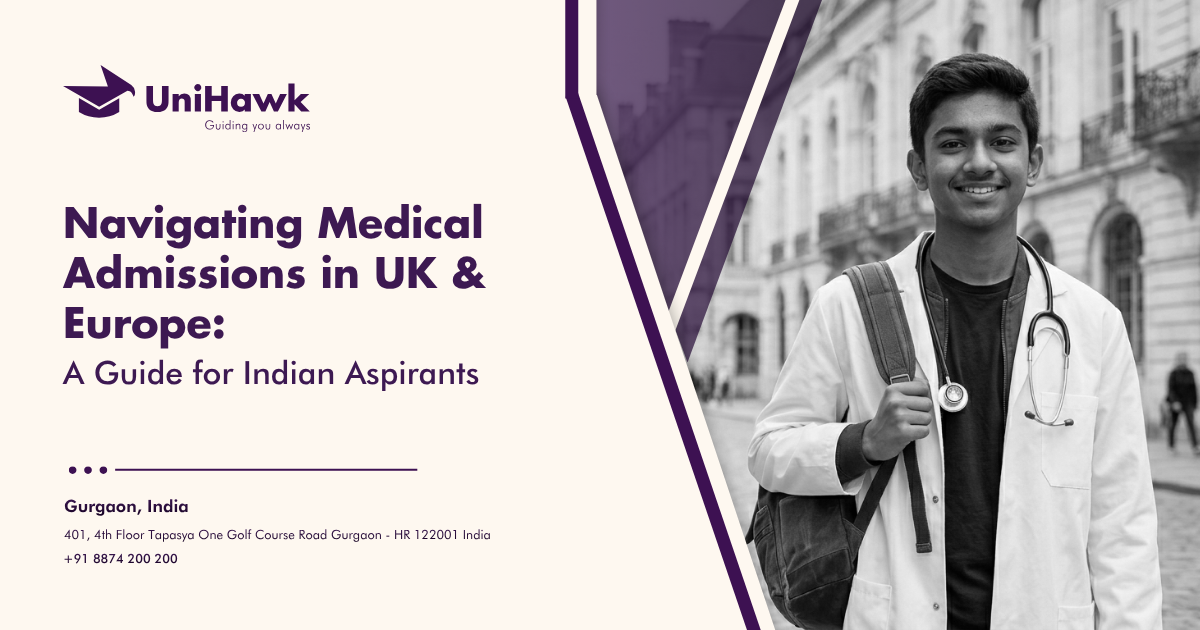
Navigating Medical Admissions in UK & Europe: A Guide for Indian Aspirants
The dream of becoming a doctor is one of the most common and deeply held aspirations among Indian students. But with fewer than one in ten NEET qualifiers securing a government medical seat in India, and private MBBS fees touching ₹80 lakh to over ₹1 crore at many institutions, an increasing number of Indian medical aspirants are looking outward – and finding genuinely world-class pathways in the UK and Europe.
This is not a compromise. For students who prepare correctly and apply strategically, medicine UK Europe India pathways offer internationally recognised degrees, NHS-integrated clinical training, and globally competitive careers. What they require is precise preparation, informed university selection, and mentorship from people who genuinely understand how these admissions systems work.
This guide gives you the full picture – what each pathway demands, how the competitive landscape looks today, and how to position yourself for success.
Why Indian Students Are Choosing UK and European Medical Schools
The case for studying medicine abroad is stronger than ever for Indian students. Around 90% of Indian students who clear the NEET exam do not get a medical seat in India. The majority of the best medical universities in Europe offer MBBS programs that are recognised by the NMC, fully in English, with tuition fees significantly lower than private Indian medical colleges.
For those targeting the UK, the draw is different – it is about the prestige, the NHS exposure, and the global career capital that a degree from Oxford, Imperial, UCL, King’s College London, or the University of Manchester provides. For those looking at Europe – Czech Republic, Hungary, Italy, Poland, and beyond – it is about high quality at significantly lower cost, with internationally accredited degrees that open doors across India, Europe, and the world.
Both pathways are legitimate. Both are competitive. And both require a very different preparation strategy from anything that Indian school curricula typically provide.
Part One: UK Medical Admissions for Indian Students
The Competitive Landscape
According to UCAS, 25,770 students applied to study medicine for current entry by the 15 October deadline – a 10.4% increase over the previous cycle. The number of funded medical school places has stayed almost the same at around 8,100 in England, meaning competition for interviews and offers is as tough as ever. Most medical schools interview only two to three applicants per place.
For Indian students, the challenge is even more concentrated. Overseas intake remains around 450 places nationwide, so international competition is intense. UK medical schools typically require international applicants to meet the same high entry standards as home students, if not higher. International candidates are often competing for dramatically fewer places, and thus need a very strategic approach.
This context makes expert medical admissions mentorship India not just helpful – it is essential.
Step 1: Academic Requirements
Indian students can apply to UK medical schools directly after Class 12 by meeting academic requirements – typically 85 to 90% in Physics, Chemistry, and Biology. They must also clear entrance exams like UCAT and qualify English proficiency tests such as IELTS.
A-Level or IB qualifications with Biology and Chemistry are strongly preferred. Students applying with Indian board results (CBSE/ISC) need to check each university’s specific equivalency criteria, which vary. This is one of the first strategic decisions where expert UK medical admissions India guidance saves significant time and prevents costly mistakes.
Step 2: UCAT – The Gateway Exam
The UCAT (University Clinical Aptitude Test) is the single most important filter in UK medical admissions. Almost every UK medical school now uses the UCAT, and understanding how each university scores your results – whether as a hurdle, a ranking tool, or part of a holistic formula – is the secret to a successful shortlist strategy.
Indian students are fully eligible to take the UCAT, and India is one of the top international applicant regions. The UCAT is available at Pearson VUE test centres in cities like Mumbai and Bangalore.
The UCAT consists of four sections: Verbal Reasoning, Decision Making, Quantitative Reasoning, and Situational Judgement. Performance on the Situational Judgement Test (SJT) deserves particular attention – most medical schools will not admit candidates who were given a Band 4 on the SJT section.
UniHawk’s UCAT preparation program and StudyMedicine’s specialist UCAT coaching are built around the diagnostic-first, strategy-led approach that consistently delivers top-percentile results for Indian students. This is not generic test prep – it is UCAT coaching designed specifically for the Indian applicant’s cognitive profile and preparation gaps.
Step 3: Personal Statement
Your UCAS personal statement is a 4,000-character document that has to tell a compelling human story about your commitment to medicine, your clinical and voluntary experience, and your understanding of what the role of a doctor actually involves. For Indian students applying as international candidates, this document carries enormous weight.
Work experience is a significant booster to your application. Experience in hospitals, shadowing a doctor, or involvement in healthcare-related volunteering all increase the strength of your application and provide material for your personal statement.
A Learning Lab by UniHawk offers structured virtual doctor shadowing programs with NHS doctors – giving Indian students meaningful, verifiable clinical experience that directly strengthens both the personal statement and the subsequent interview. These are not token activities – they are real professional exposure that admissions committees recognise and value.
Step 4: MMI Interview Preparation
The Multiple Mini Interview (MMI) is the standard interview format at most UK medical schools. It consists of rotating stations testing communication, ethical reasoning, empathy, situational judgment, and knowledge of the NHS and healthcare values. It is a skill – and one that can absolutely be taught and developed through practice.
MMI preparation for Indian medical applicants involves working through real-world scenarios, receiving detailed feedback on communication style, and building the confidence to perform under pressure in a format that is genuinely unlike anything encountered in Indian academic settings. UniHawk’s UK Medicine and Dentistry admissions program provides end-to-end support including dedicated MMI coaching.
Step 5: Strategic University Shortlisting
Smart university selection is crucial for international students. It is wise to include a mix of aspirational and matched universities in your four UCAS choices, rather than applying exclusively to the most selective institutions with very low international acceptance rates.
Top institutions for Indian students include: Imperial College London, King’s College London, UCL, University of Manchester, University of Edinburgh, Queen Mary University of London, University of St Andrews (linked with Manchester), and Newcastle University. Each has different UCAT thresholds, different weightings for academic performance, and different approaches to international applicants.
Part Two: Europe MD Admissions for Indian Students
Why Europe Is a Compelling Alternative
Studying MBBS in Europe is a practical and cost-effective option for Indian students seeking globally recognised medical education, modern infrastructure, and strong clinical exposure without the burden of high fees or donations. With multiple countries offering English-medium programs and affordable tuition, students have flexible choices based on budget and career goals.
More than 25,000 Indians opt for MBBS in Europe at top universities such as Charles University in the Czech Republic. Tuition fees typically range from EUR 3,000 to EUR 20,000 annually, depending on the country, and the MBBS is taught in English at the majority of European universities.
Top Countries for MBBS in Europe for Indian Students
Czech Republic – Charles University in Prague is one of the oldest and most respected medical universities in the world, with a strong emphasis on research alongside clinical training. It is among the premium European destinations for Indian students targeting UK or US residencies.
Hungary – Semmelweis University and the University of Debrecen have strong global reputations, modern facilities, and experienced clinical faculty. The fees are higher than some European destinations, but students receive exceptional practical training and internationally competitive degrees.
Italy – The IMAT (International Medical Admission Test) is the gateway to English-taught medicine at Italian public universities. Italy provides high-quality public medical education in English at a reasonable price, with a fully merit-based, donation-free selection system. A single national-level exam determines admission to multiple universities. Italian public university fees range from ₹1 lakh to ₹4 lakhs per year, heavily based on your family’s income equivalency.
Poland – NMC and WHO approved, USMLE-friendly, and increasingly popular. Fees range from ₹8 lakhs to ₹12 lakhs per year, with a total six-year cost between ₹50 and ₹70 lakhs. No entrance exam is required by most Polish universities, and the admission process is relatively straightforward.
European Medicine Entrance Exams
Unlike the UK’s unified UCAT system, European medical school admissions have country and university-specific entrance assessments. Italy has the IMAT. Hungary and Czech Republic universities have their own biology and chemistry-based entrance tests or interviews. Romania and most Polish universities admit on academic merit without a separate exam.
UniHawk’s European medicine entrance exam preparation program covers the specific requirements of each destination, giving Indian students targeted coaching rather than generic science revision.
NEET and European Admissions: What Indian Students Must Know
According to the National Medical Commission (NMC) guidelines, NEET qualification is mandatory for Indian students who wish to return to India to practice medicine. Even if some European universities allow admission without NEET, students who have not qualified will not be eligible for the FMGE/NExT exam in India.
This is a critical planning point that every Indian family considering an MBBS abroad must address before choosing a destination or institution.
UniHawk’s Europe Medicine Admissions Support
StudyMedicine by UniHawk’s Europe Medicine admissions program provides full-service support for Indian students targeting Charles University, Semmelweis, University of Debrecen, Italian IMAT-pathway universities, and other leading European institutions. This includes university selection, entrance exam coaching, personal statement and motivation letter guidance, visa support, and post-admission orientation.
Building a Profile That Works for Both Pathways
Whether you are targeting the UK or Europe, admissions committees are looking for more than academic grades. They want evidence of genuine engagement with medicine – clinical exposure, healthcare volunteering, leadership, and a clear understanding of what practising medicine actually means.
A Learning Lab by UniHawk addresses this directly through its Doctor Shadowing programs, Harvard Youth Leadership Conferences, and medically focused virtual courses like “Doctor Who?” and “Doctor You!” – all designed to help Indian students build the kind of profile that medical schools respond to.
UniHawk India: Your End-to-End Medical Admissions Partner
UniHawk India, based in Gurgaon, and StudyMedicine by UniHawk together provide the most comprehensive medical admissions mentorship India available – covering both the UK and European pathways, with specialist support for UCAT preparation, MMI coaching, European entrance exams, personal statement guidance, and full admissions strategy.
With students admitted to Imperial College London, University of Manchester, Charles University, and Semmelweis University, UniHawk’s track record in MD admissions India is built on genuine outcomes, not generic promises.
UniHawk’s global reach across the GCC means the insights informing your preparation come from a truly international network. Explore UniHawk’s locations across the GCC, including UniHawk Riyadh, UniHawk Bahrain, UniHawk Sharjah UAE, UniHawk Dubai Media City, UniHawk Dubai DIFC, UniHawk Abu Dhabi, UniHawk Qatar, UniHawk Kuwait, UniHawk Muscat Oman, and UniHawk India Gurgaon.
Frequently Asked Questions: Medicine UK Europe India
Do Indian students need NEET to apply for UK medical schools?
No. NEET scores are not used for UK medical school admissions. Students must apply through UCAS and sit the UCAT. However, NEET qualification remains mandatory for Indian students who intend to return to practice medicine in India after completing their degree abroad.
How long does an MBBS take in the UK and Europe?
In the UK, undergraduate medicine is typically a five-year program, with some universities offering six-year courses with an intercalated year. In Europe, most programs are six years including a mandatory internship component.
Can I pursue the UK and Europe pathways simultaneously?
Yes – and for many students, building a parallel application strategy across both pathways is the smartest approach. UniHawk’s advisors help students develop applications for UK medical schools through UCAS while simultaneously preparing for European entrance exams, maximising the total number of viable offers available.
When should Indian students start preparing for UK or European medical admissions?
The preparation journey for UK medicine ideally begins in Class 10 or early Class 11. UCAT preparation, clinical experience building, and personal statement development all require time. For European pathways, Class 12 completion with strong PCB marks is the foundation, with entrance exam preparation running in parallel.
Start Your Medical Journey Today
The UK and European medical school guide India journey is demanding – but it is entirely achievable for well-prepared, strategically positioned Indian students. Thousands of students from India are already studying at Oxford, Imperial, Charles University, and Semmelweis. The difference between them and those who did not make it is almost never raw ability. It is preparation quality, strategy, and the guidance behind the application.
Book your free consultation with UniHawk India today and take the first step toward your medical degree at one of the world’s leading universities.
Recommended “Read Next” Blog Titles
- How Indian Students Can Get Into UK Medical Schools: Step-by-Step Guide
- MBBS in Europe vs India: Which is Better for Indian Students?
- UCAT Preparation Guide for Indian Students Applying to UK Medical Schools
- Top European Medical Universities for Indian Students in 2026
- Cost of Studying Medicine in UK vs Europe for Indian Students
- NEET vs UCAT vs IMAT: Which Exam Do You Need for MBBS Abroad?
- Best Countries in Europe for MBBS for Indian Students
- How to Build a Strong Medical Profile for UK & Europe Admissions
- Study Medicine Abroad After Class 12: UK & Europe Options
- UK Medical School Interview (MMI) Preparation Guide for Indian Students